

Hedges serve a number of really useful purposes in a garden so here is our guide to panning and growing a hedge that looks great and does what you need it to do.
Uses For Hedges
Some of the many different reasons for introducing hedge to your garden include:
- The creation of boundaries and tidy divided areas.
- Providing shelter from the wind, cold winter weather, and frost for your other plants.
- Providing visual interest / a focal point e.g., topiary.
- Providing shelter for birds and wildlife.
- Providing privacy and shade in certain areas of the garden.
Planning A Hedge In Your Garden
How you plan a hedge depends on your garden’s size, layout, the surrounding area (perhaps neighbouring gardens), the purpose of the hedge, the soil, and the type of hedge plants you want to use. Some helpful tips for planning your hedge can be:
- Prepare the soil by making sure that a large enough section has been dug through e.g., 60-90cm/2-3ft wide, make sure all weed roots are removed (they’d be hard to reach afterwards), make sure the drainage is good, an avoid putting organic matter in the bottom of the trench to avoid stunting the hedge.
- Ensure that your hedge gets plenty of water in first two years.
- If using a hedge for a boundary, make sure it’s set back enough from the wall/fence enough not to overhang a neighbouring property e.g., by 3 ft/90 cm.
- When choosing the type of hedge plants, bear in mind that small hedge plants/’whips’ (around 2ft high) are cheaper and easier to establish than larger hedge plants, which often need more care and are more expensive. Whips should also be planted closely to form a thick hedge and reduce trimming work.
- Evergreen and semi-evergreen hedges like box, privet (semi-evergreen) and Yew are best planted in Early autumn, and deciduous hedges such as hawthorn or hornbeam any are best planted from mid-autumn to late winter.
What To Look For In A Hedge Plant
Plants used to grow hedges need to provide the right appearance and density, provide the right levels of height (if needed), not require excessive trimming maintenance, and should be able to thrive in your particular garden conditions.
3 Perfect Hedge Plants
Examples of 3 types of hedge plant that work well in many gardens include:
1.Common Yew / Taxus Standshii
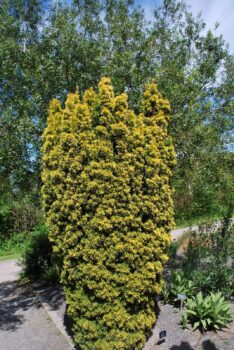
Common Yew / Taxus Standshii is a dense, upright evergreen conifer shrub with columnar, erect branches. This plant works well in architectural schemes, and along walkways to create an impact for visitors. Taxus Standshii is a favourite in award winning gardens and famous gardens such as Longleat house and many more.
2.Aucuba Japonica / Japanese Laurel.
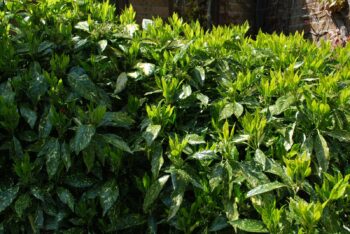
Aucuba Japonica / Japanese Laurel (variegated leaves in this case) is a bushy, evergreen shrub with glossy green medium sized leaves. When planted in groups, this shrub can make a perfect hedge, screening plant.
3. Griselinia Littoralis / Broadleaf
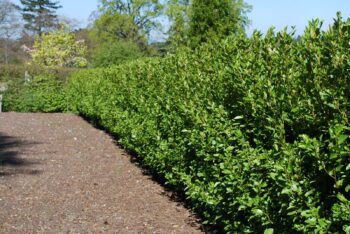
Commonly known as Broadleaf, Griselinia Littoralis is a fast growing, bushy, evergreen shrub. Quickly establishing into a dense, bushy plant, several Griselinia Littoralis planted closely together can create a light screening bush or hedge. Another advantage of this plant is that it is salt tolerant so can be planted in coastal gardens.